
Abydos and Dendera Temples: Incredible Sacred Wonders

Visiting the magnificent Abydos and Dendera temples offers travelers a rare glimpse into Egypt’s most intact pharaonic art and religious rituals. In fact, these two archaeological sanctuaries provide a vibrant spiritual journey that standard tour routes often overlook. Travelers journey north of Luxor to see these sites, unlocking thousands of years of profound myth and astronomical observation.
Moreover, both sites reveal breathtaking craftsmanship that survived millennia of desert weathering. Therefore, planning an excursion to these distinct monuments will transform your understanding of Upper Egypt’s sacred past. You can easily connect this visit with our comprehensive Egypt Ancient Civilization: 9 Incredible Secrets of the Pharaohs guide to contextualize these awe-inspiring monuments.
Why Abydos and Dendera Temples Belong on Your Itinerary
Most travelers focus solely on the classic ruins of Luxor, Karnak, and the West Bank. However, exploring the this experience reveals some of the best-preserved ceiling reliefs and ceremonial halls in the ancient world. In addition, the intricate stone carvings at these sanctuaries retain original turquoise, gold, and lapis lazuli pigments that leave historians breathless.
Furthermore, ancient pilgrims regarded both sites as foundational centres of cosmic order and divine rebirth. Dendera celebrated the nurturing power of Hathor, whereas Abydos served as the supreme burial center of Osiris. As a result, experiencing both sites together presents an unmatched dual narrative of celestial harmony and eternal life.
Abydos and Dendera temples: Marveling at the Sanctuary of Dendera
Dendera sits roughly 60 kilometers north of Luxor on the west bank of the Nile. For example, the temple complex features enclosing mudbrick walls, Roman birth houses, and an intact Coptic basilica. Consequently, visitors step through a layered historical threshold that spans Egyptian, Ptolemaic, and Roman eras.
Vivid Ceilings and the Hathoric Facade
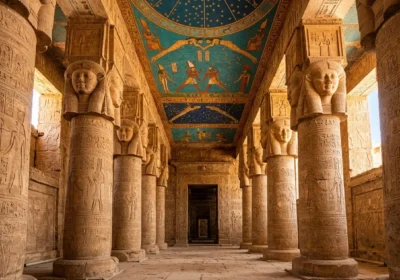
Upon arrival, twenty-four colossal columns capped with the benevolent face of Hathor greet you in the main hypostyle hall. In fact, ongoing cleaning efforts by Egypt’s Supreme Council of Antiquities have unveiled cobalt-blue skies across the ceilings. Visitors can observe intricate carvings of sky goddess Nut, who swallows the sun disk each dusk and births it anew at dawn.
Moreover, astronomical charts spread across the plaster illustrate decans, constellations, and the journey of the sun barge through twelve celestial gates. In addition, the famous depiction of the Dendera Zodiac, now preserved in the Louvre, originated here as a unique astronomical masterpiece. You can learn more about its historical timeline on Wikipedia’s Dendera Temple complex page. Therefore, seeing these vivid stone ceilings in real life remains an irreplaceable experience.
Mysterious Crypts and Cleopatra’s Legacy
Below the temple flooring lie narrow underground crypts carved with exquisite relief work. In addition, the famous Dendera light bulb reliefs adorn these deep chamber walls, sparking countless mystical debates. Meanwhile, archaeologists confirm these images symbolize royal lotus blossoms birthing primordial snakes within protective serpent djed pillars.
Around the outer back wall, an imposing low relief depicts Queen Cleopatra VII and her son Caesarion offering incense to the gods. Consequently, Dendera stands as one of the few surviving monuments showcasing the legendary Ptolemaic queen in her full royal regalia. For deeper context on her fascinating reign, check out our piece on Cleopatra: The Last Queen of Egypt – 10 Fascinating Facts.
Abydos and Dendera temples: Uncovering the Mysteries at Abydos
Further north, approximately 135 kilometers from Luxor, lies the sacred necropolis of Abydos. Historically, every ancient Egyptian yearned to make a pilgrimage here or at least erect a funerary memorial tablet. In fact, Abydos served as the sacred gateway to the underworld, directly tied to Osiris, lord of resurrection.
The Cenotaph of Seti I and Exquisite Bas-Reliefs
The Great Temple of Seti I dominates the archaeological landscape with its unique L-shaped architectural blueprint. Additionally, scholars widely consider the delicate low reliefs inside Seti’s seven vaulted chapels the artistic zenith of the New Kingdom. For instance, the wall carvings demonstrate tender emotional interactions between Pharaoh Seti I and Egypt’s supreme deities.
Furthermore, each chapel honors a specific god: Horus, Isis, Osiris, Amun-Ra, Ra-Horakhty, Ptah, and the deified Seti himself. As a result, the sensory impact of these sacred sanctuaries mesmerizes art lovers and spiritual seekers alike.
The Royal Abydos King List
Deep within the gallery of the temple sits the legendary Abydos King List. Therefore, historians view this long corridor as an indispensable historical archive that traces pharaonic legitimacy. King Seti I stands alongside his young son, the future Ramses II, offering honor to 76 royal ancestors inscribed within royal cartouches.
However, the list deliberately omits disputed rulers like Hatshepsut, Akhenaten, and Tutankhamun to maintain state orthodoxy. Nevertheless, this stone chronicle proved vital for modern Egyptologists establishing imperial timelines. You can discover more about Seti’s celebrated successor in our detailed feature on Ramses II: Egypt’s Greatest Pharaoh – 10 Powerful Facts.
The Enigmatic Osireion
Immediately behind the temple of Seti I rests the subterranean Osireion, an enigmatic subterranean monument built from massive granite megaliths. In contrast to the ornate bas-reliefs nearby, this submerged hall features minimalist, austere stone columns reminiscent of Old Kingdom pyramid temples. In addition, archaeologists study its ancient water channels to understand how underground aquifers symbolized the primeval waters of Nun.
Furthermore, visitors can read comprehensive geological and archaeological analyses of this sacred site through the digital archives of the Metropolitan Museum of Art. Consequently, the subterranean chamber remains one of Egypt’s most enduring engineering mysteries.
Planning Your Abydos and Dendera Temples Excursion
Organizing a combined journey to the Abydos and Dendera temples requires strategic preparation and an early departure. Because both sites sit north of Luxor along the agricultural Nile valley, travelers usually hire a private vehicle with an Egyptologist guide. Additionally, private transportation guarantees total comfort, climate-controlled interiors, and personal pacing.
Typically, tours depart Luxor around 7:00 AM to reach Abydos first before tourist crowds gather. After exploring the sacred cenotaph of Seti I, drivers head south to stop at Dendera during the softer afternoon illumination. Finally, visitors return to Luxor around dusk, having completed a transformative 10-hour historical exploration.
Abydos and Dendera temples: Logistics, Tickets, and Travel Regulations
Purchasing entrance tickets to both sites is straightforward thanks to digital ticketing kiosks at each temple entrance. However, the Egyptian Ministry of Tourism and Antiquities requires international debit or credit cards for foreign visitor payments. For example, entrance tickets to Dendera run approximately 240 EGP, whereas Abydos costs around 260 EGP per person.
Moreover, local currency exchange rates fluctuate, so travelers should carry spare Egyptian Pounds (EGP) for tips, restrooms, and refreshments. In contrast, travelers booking through a curated luxury package often have entry fees, private licensed transportation, and mineral water included in the overall quote. In fact, coordinating your schedule alongside our Best Places to Visit in Luxor: 15 Amazing Historical Sites ensures an efficient, seamless itinerary.
Abydos and Dendera temples: Photographic Advice for Ancient Relic Enthusiasts
Capturing the intricate art throughout the Abydos and Dendera temples demands thoughtful camera settings. Because the interior sanctuaries and crypts maintain minimal artificial lighting, a fast lens with wide aperture performs best. In addition, mobile phone cameras with advanced night-mode technology capture remarkable shadow detail without disrupting delicate pigments.
However, security guards strictly prohibit flash photography inside all painted chambers to preserve colors from UV degradation. Furthermore, tripods generally require special permits or nominal ticketing add-ons at entrance gates. Therefore, stabilizing your camera by hand against columns or walls produces brilliant, crisp exposures.
Comparing Architectural Highlights Across Both Sites
- Dendera Temple of Hathor: Houses towering columns, deep ritual crypts, exterior Cleopatra reliefs, and restored astronomical ceilings.
- Abydos Temple of Seti I: Showcases the historic King List, seven painted vaulted sanctuaries, and the megalithic Osireion.
- Visual Character: Dendera delivers vibrant Greco-Roman colors, while Abydos presents pristine 19th-Dynasty New Kingdom limestone reliefs.
- Spiritual Meaning: Dendera honors feminine joy, fertility, and cosmic order; Abydos celebrates Osiris, ancestral lineage, and the afterlife.
Therefore, pairing these two unique destinations gives travelers a balanced, all-encompassing appreciation of Upper Egyptian art.
Why Choose Egypt Voyagers for Your Historical Journey
Egypt Voyagers provides dedicated Egypt Historical Tours tailored to curious minds seeking authenticity and comfort. In fact, our private transfers feature experienced local drivers and vetted, multilingual Egyptologists who unlock the deepest secrets of ancient ruins. As a result, travelers bypass logistics headaches and immerse themselves directly in timeless wonders.
Moreover, whether you desire a specialized day excursion or an extended Nile journey, our team customizes every detail. Consequently, your trip to the Abydos and Dendera temples becomes a highlight of your vacation. Contact Egypt Voyagers today to reserve your unforgettable expedition into the heart of pharaonic greatness.