

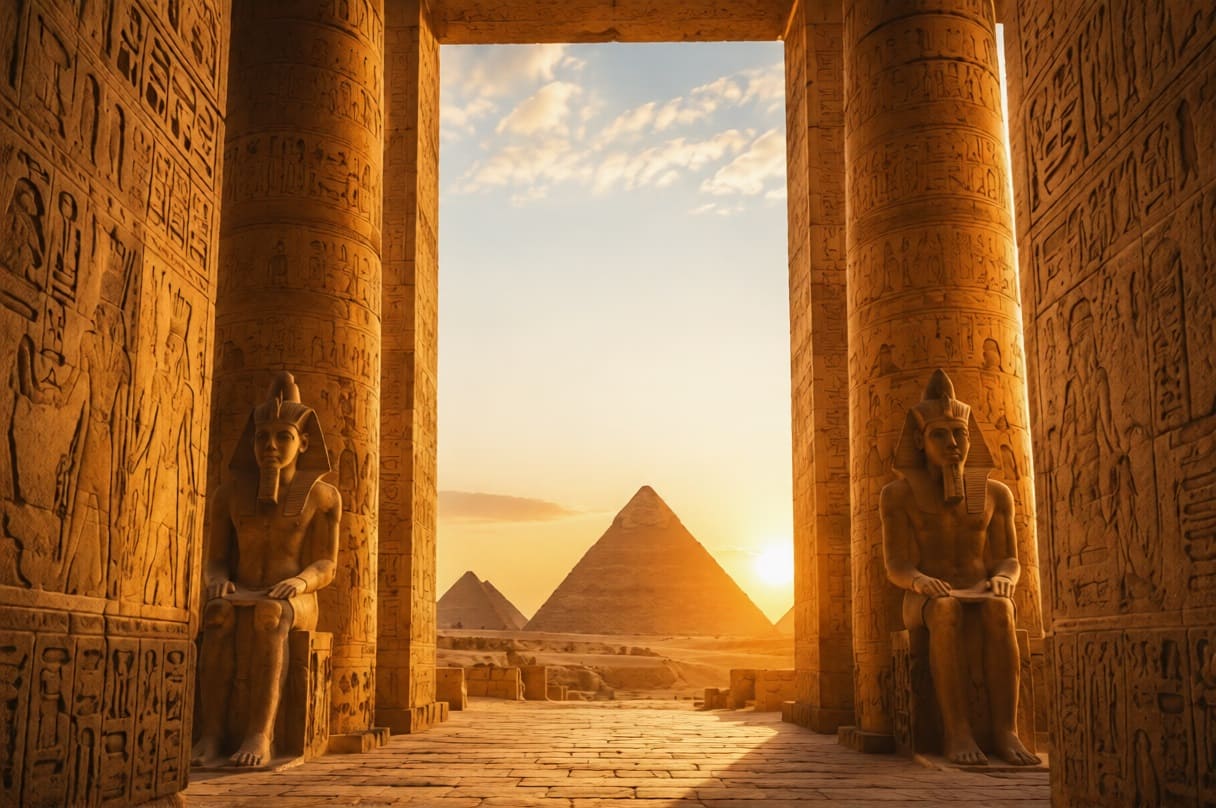
How Were the Pyramids Really Built? 10 Amazing Secrets of Ancient Egypt
How Were the Pyramids Really Built? 10 Amazing Secrets of Ancient Egypt
How Were the Pyramids Built? This is one of the most fascinating questions in the history of Ancient Egypt. For more than 4,500 years, the enormous pyramids have amazed historians, archaeologists, engineers, and travelers. Their enormous size, precise design, and remarkable survival make them some of the greatest monuments ever created.
Archaeological discoveries have provided important answers to how the pyramids were built, revealing evidence about quarrying, transportation, surveying, construction tools, workers, and ancient engineering. Although some details remain debated, researchers now understand much more about the practical methods used by Egyptian builders.
The pyramids were not built using mysterious forces or lost advanced technology. Instead, their construction depended on careful planning, skilled workers, mathematics, engineering, quarrying, transportation, and an enormous organizational effort. The Great Pyramid of Giza, built for Pharaoh Khufu, remains the greatest surviving example of this achievement.
Learning How Were the Pyramids Built also provides a fascinating look at Ancient Egyptian society. The project required much more than moving stones. Workers needed food, housing, tools, transportation, medical care, and an administrative system capable of coordinating a huge construction project.
This guide reveals 10 amazing secrets behind how the pyramids were built, using archaeological evidence to explain the construction methods behind some of Egypt’s most famous monuments.
How Were the Pyramids Built? The Ancient Egyptian Method
The answer to How Were the Pyramids Built involves several stages rather than one single construction technique. Ancient Egyptian builders first selected suitable locations, planned the dimensions, organized quarries, prepared foundations, transported materials, and gradually raised the structure.
Different pyramids were constructed during different periods and under different circumstances. Therefore, there was probably no single method that explains every pyramid in Egypt.
However, the Great Pyramid of Giza provides some of the strongest evidence available because archaeologists have discovered extensive remains around the Giza Plateau.
1. The Egyptians Planned the Pyramid Before Construction
The first stage in understanding how the pyramids were built is recognizing the extraordinary amount of planning involved.
Builders needed to determine the pyramid’s location, orientation, dimensions, internal chambers, entrances, temples, and surrounding structures.
Surveyors also had to create an extremely level foundation. The Great Pyramid’s base demonstrates remarkable precision, showing that Egyptian surveyors possessed sophisticated practical knowledge.
The pyramid was also aligned very closely with the four cardinal directions. Ancient builders may have used astronomical observations to establish these orientations.
This careful preparation created the foundation for everything that followed.
2. Stone Was Quarried From Different Locations
Another important part of How Were the Pyramids Built involves understanding where the construction materials came from.
The pyramids were constructed mainly from limestone, although other stones were used in important areas.
Local limestone was available around the Giza Plateau, making it possible to obtain large quantities of building material relatively close to the construction site.
Higher-quality limestone used for the outer casing was transported from Tura. Granite used in parts of the Great Pyramid’s internal structure came from Aswan, hundreds of kilometers south of Giza.
Moving these materials required an efficient transportation network involving both land and water.
3. Ancient Workers Used Simple but Effective Tools
Ancient Egyptian builders did not have modern cranes, trucks, engines, or electric tools. However, they possessed effective technologies appropriate for their time.
Copper tools were used for working certain types of stone, while harder stone tools helped shape tougher materials.
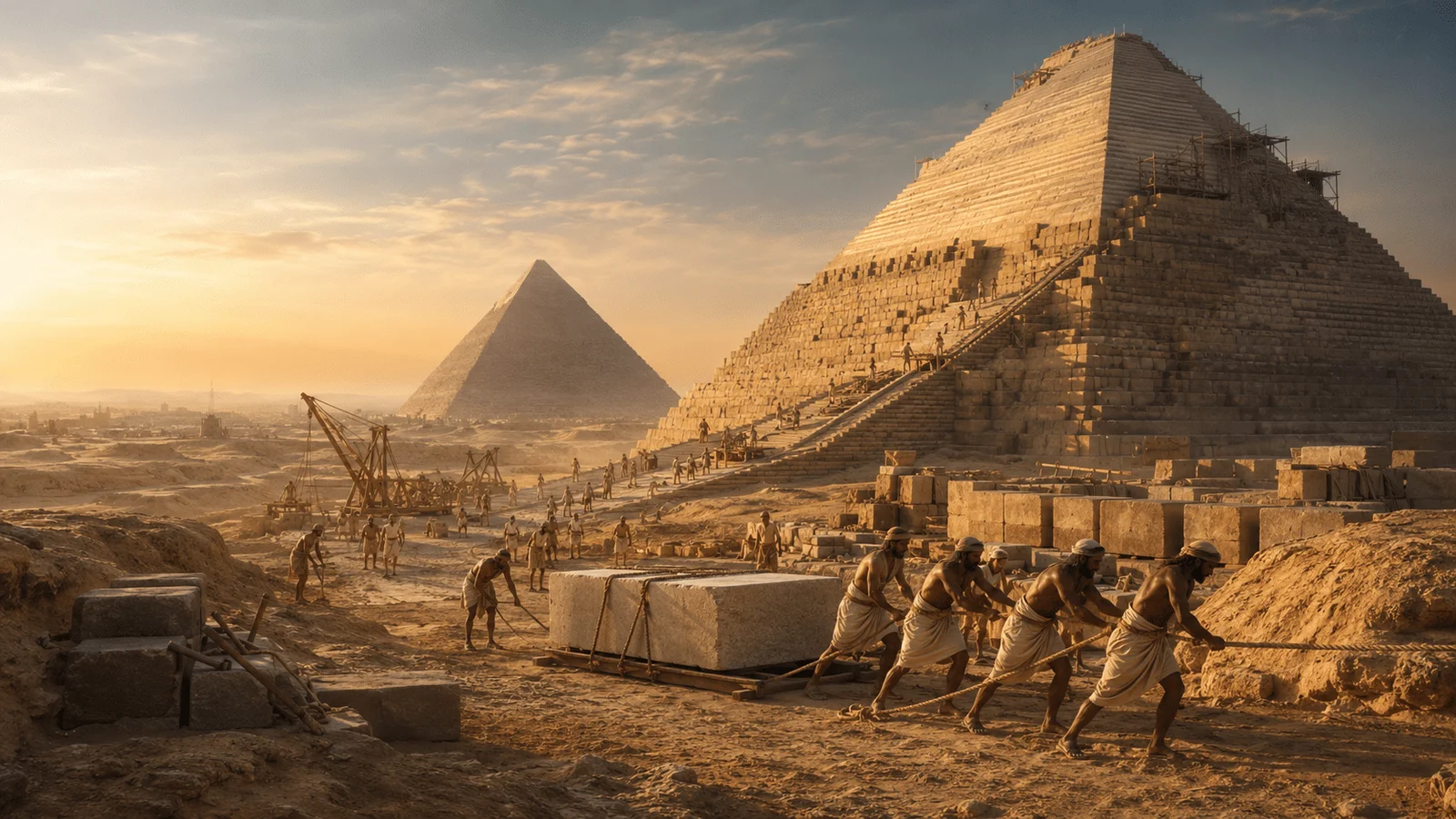
Workers also used wooden sledges, ropes, levers, boats, and other simple mechanical devices.
The real achievement was not one revolutionary machine. Instead, Egyptian builders combined many relatively simple technologies with skilled craftsmanship and careful organization.
This combination helps explain how the pyramids were built on such an enormous scale.
4. Workers Transported Heavy Stones on Sledges
One of the most important clues about How Were the Pyramids Built comes from evidence for transporting heavy stone blocks.
Workers could place blocks on wooden sledges and pull them across prepared surfaces.
Ancient Egyptian artwork depicts teams of workers pulling large objects on sledges. Modern experiments have also shown that adding water to sand can reduce the resistance experienced by a moving sledge.
This technique could have made it easier for workers to transport heavy blocks across land.
The method demonstrates how the Egyptians could use simple physical principles to solve enormous engineering challenges.
5. The Nile River Was Essential to Construction
The Nile River was one of the most important parts of the ancient Egyptian transportation system.
Stone and other materials from distant regions could be transported by boat toward the pyramid construction areas.
Archaeological discoveries around Giza have provided evidence of ancient waterways and harbor facilities associated with the construction project.
Materials arriving from distant quarries could therefore travel by water before being transferred to sledges and moved over land.
The Nile was much more than the agricultural heart of Egypt. It was also an essential route for moving people, food, stone, and other supplies.
6. Ramps Probably Helped Raise the Stones
The question of How Were the Pyramids Built naturally leads to another question: how did workers move stones upward as the pyramid became taller?
Ramps are among the most widely discussed explanations.
Researchers have proposed several possible designs, including straight ramps, zigzag ramps, and ramps that may have surrounded parts of the structure.
The exact design remains uncertain, and different ramp systems may have been used at different stages.
However, ramps combined with sledges, ropes, and organized labor could have allowed workers to gradually move stones to higher levels.
Rather than depending on one enormous ramp throughout the entire project, Egyptian builders may have adapted their methods as construction progressed.
7. Workers Used Levers and Mechanical Techniques
Levers may have played an important role in positioning blocks.
After a stone reached approximately the correct location, workers could use wooden levers to make small adjustments and align it accurately with surrounding blocks.
This would have been particularly useful during the later stages of construction when precision became increasingly important.
Ancient Egyptian builders understood practical mechanics through experience even though they did not use modern engineering terminology.
Their ability to combine leverage, friction reduction, ropes, sledges, and ramps was central to how the pyramids were built.
8. The Pyramids Required an Organized Workforce
Another important discovery concerns the people who actually constructed these monuments.
For many years, popular stories portrayed pyramid construction as the work of enormous numbers of slaves. Archaeological evidence from Giza provides a more complicated picture.
Excavations have revealed organized settlements containing evidence of food production, workshops, storage facilities, and other services supporting workers.
The workforce included laborers, stoneworkers, carpenters, boat crews, surveyors, administrators, cooks, bakers, and other specialists.
Some workers may have been seasonal laborers who worked on state projects when agricultural demands were lower.
This evidence shows that pyramid construction was a highly organized national project supported by the Egyptian state.
9. Mathematics Was Essential to Pyramid Construction
Mathematics played a major role in How Were the Pyramids Built.
Builders needed to calculate dimensions, angles, distances, levels, and proportions.
The Great Pyramid demonstrates remarkable precision. Its sides are oriented extremely closely to the cardinal directions, while its enormous base is remarkably level.
Ancient Egyptian surveyors developed practical methods for measuring and maintaining these proportions.
They did not need modern computers or surveying instruments to achieve impressive accuracy. Careful observation, geometry, measurement, and repeated checking were sufficient to produce extraordinary results.
10. The Finished Pyramid Looked Completely Different
One of the most surprising facts about the pyramids is that they did not originally look like the monuments visitors see today.
The Great Pyramid was once covered with smooth, polished white limestone casing stones.
These stones would have created a bright outer surface that reflected sunlight and made the pyramid appear dramatically different from its present rough appearance.
Most of the original casing disappeared over thousands of years because of erosion, earthquakes, human activity, and the reuse of building materials.
The structure visible today is therefore largely the inner core of a monument that was once much smoother and brighter.
How Long Did It Take to Build the Great Pyramid?
The exact construction period remains uncertain, but the Great Pyramid was built during the reign of Pharaoh Khufu.
Many estimates suggest that the project may have taken around two decades, although the precise number of years remains debated.
During this period, quarrying, transportation, stone preparation, surveying, and construction had to continue on a massive scale.
Maintaining such a project required an extraordinary administrative system capable of supplying thousands of workers and coordinating materials from different regions.
Who Actually Built the Egyptian Pyramids?
Evidence from Giza indicates that pyramid construction depended on an organized workforce rather than a simple system of forced labor.
Workers included skilled craftsmen, general laborers, administrators, surveyors, carpenters, boat crews, cooks, bakers, and other specialists.
The discovery of workers’ settlements has provided valuable information about their living conditions and daily activities.
These discoveries have changed our understanding of how the pyramids were built and who was responsible for their construction.
The pyramids were enormous state projects requiring cooperation between many different professions.
How Were the Pyramids Built So Accurately?
The precision of Egyptian pyramids remains one of their most impressive characteristics.
Surveyors needed to establish accurate directions and create level foundations before major construction began.
Astronomical observations may have helped determine the orientation of the pyramid, while practical surveying techniques allowed builders to maintain accurate dimensions.
The Great Pyramid’s precision demonstrates the effectiveness of Ancient Egyptian mathematics and engineering.
Its accuracy should not be interpreted as evidence of modern or supernatural technology. Instead, it shows what highly skilled workers could achieve through careful observation, measurement, planning, and repetition.
What Was the Purpose of the Pyramids?
The pyramids were primarily royal funerary monuments.
Ancient Egyptians believed that the pharaoh had an important religious role and that the king’s relationship with the gods continued after death.
The pyramid was therefore part of a larger funerary complex that included temples, ceremonial routes, burial areas, and other structures.
The monumental scale also demonstrated royal authority and the organizational power of the Egyptian state.
Understanding this religious purpose helps explain why so much effort was invested in pyramid construction.
The Great Pyramid of Giza: The Greatest Example
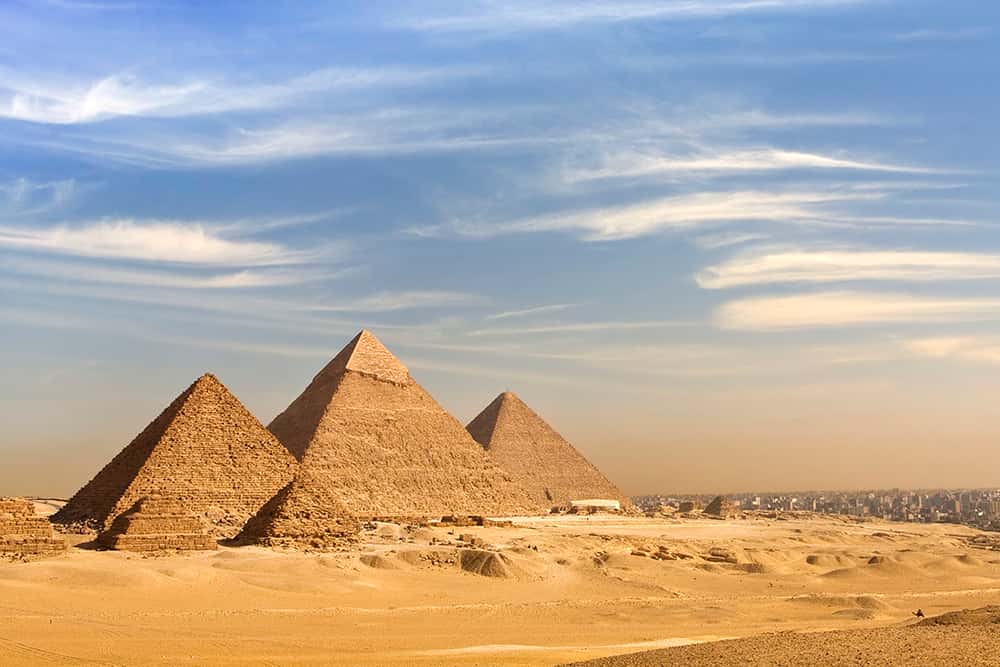
The Great Pyramid of Giza is the most famous example of Egyptian pyramid construction.
Built for Pharaoh Khufu, it originally reached approximately 146.6 meters in height and remained the tallest human-made structure in the world for thousands of years.
Its enormous dimensions, precise orientation, internal chambers, and surrounding archaeological evidence make it one of the most important monuments for understanding how the pyramids were built.
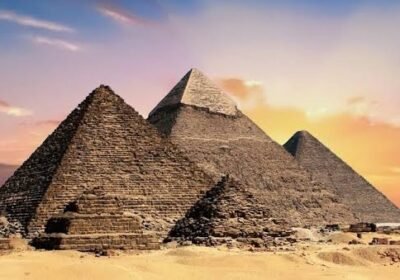
The nearby pyramids of Khafre and Menkaure provide additional evidence about the development of royal pyramid construction during the Fourth Dynasty.
Together, the three main pyramids form one of the world’s most famous archaeological landscapes.
What Archaeology Has Revealed About Pyramid Construction
Modern archaeology has dramatically improved our understanding of pyramid construction.
Excavations around Giza have revealed workers’ settlements, tools, food remains, administrative evidence, and transportation infrastructure.
Ancient papyri discovered at the Red Sea have also provided valuable information about the transportation of limestone and supplies during Khufu’s reign.
These discoveries demonstrate that pyramid building depended on logistics, organization, transportation, engineering, and skilled labor.
Although some details remain uncertain, archaeological evidence provides a much clearer picture than many popular theories suggest.
Frequently Asked Questions
How Were the Pyramids Built?
The pyramids were built using a combination of quarrying, transportation, sledges, ropes, ramps, levers, surveying, mathematics, and organized labor. Different pyramids may have used different techniques depending on their size, period, and location.
How Were the Pyramids Built Without Modern Machines?
Ancient Egyptian builders relied on relatively simple technologies, including wooden sledges, ropes, boats, ramps, levers, and stone-working tools. Their success came from combining these technologies with careful planning and large-scale organization.
Who Built the Great Pyramid of Giza?
The Great Pyramid was built for Pharaoh Khufu by an organized workforce that included skilled craftsmen, laborers, administrators, surveyors, and support workers.
How Long Did Pyramid Construction Take?
The Great Pyramid may have taken approximately two decades to complete, although the exact construction period is uncertain.
Did Slaves Build the Egyptian Pyramids?
Archaeological evidence does not support the traditional claim that the pyramids were built entirely by slaves. Evidence from Giza points to an organized workforce containing skilled workers and laborers supported by a larger administrative system.
What Was the Biggest Challenge in Building the Pyramids?
Moving and accurately positioning enormous quantities of stone was one of the greatest challenges. The builders also needed to manage food, transportation, labor, tools, surveying, and construction logistics.
Conclusion
So, How Were the Pyramids Built? The strongest archaeological evidence points to a remarkable combination of organization, engineering knowledge, mathematics, transportation, and skilled human labor.
Ancient Egyptian builders used quarries, boats, sledges, ropes, ramps, levers, surveying techniques, and carefully planned construction processes to transform enormous quantities of stone into monumental structures.
The Great Pyramid of Giza demonstrates what an organized ancient civilization could accomplish without modern machinery. Its survival for more than 4,500 years makes it one of humanity’s greatest architectural achievements.
The mystery of pyramid construction continues to inspire archaeological research. However, the evidence already tells an extraordinary story: the pyramids were built through knowledge, planning, teamwork, practical engineering, and generations of accumulated Egyptian experience.